A practical framework for bridging the gap between sales commitments and delivery execution, including handoff-hygiene checklists and role-clarity mapping.
Strategy to Execution, part 3
The deal is signed and the champagne is open. Two weeks later, the delivery team is staring at a backlog nobody can build.
Strategy also breaks at a less obvious seam: between what sales promised and what delivery can build. I have sat in both chairs. This article shows why the handoff is a design problem, not a paperwork problem, and gives you a three-part translation layer, a checklist and a four-step plan for next week.
You know the story. The sales team wins a new client on a multi-year contract. High fives all around.
Then the handoff happens.
The delivery team opens the project folder and finds a 300-page RFP, a 50-slide deck and a spreadsheet of "requirements" that contradict each other. The salesperson has moved on to the next deal. The client expects delivery yesterday. And the delivery lead is left holding a bag of promises that nobody knows how to unpack.
This is not a failure of sales or of delivery. It is a translation failure.
We treat the handoff as a paperwork exercise. When sales commitments are not translated into an executable backlog, you get:
The research backs the pattern. PMI's Pulse of the Profession research names effective communication to all stakeholders as the most crucial success factor in projects, and PMI reports that 56% of the money spent on projects is at risk because of ineffective communication (PMI 2013). A sales-to-delivery handoff is communication under maximum pressure.
The translation layer is the deliberate step that turns sales commitments into an executable backlog. It is not a meeting and it is not an email. It is a designed step that makes sure what was sold can be built, and what gets built matches what was sold.
Think of it as the architect's blueprint between the sales pitch and the developer's keyboard. Without it, the team builds from a pitch deck.
In my work with service-based companies, I have seen this gap swallow margin and burn through team morale. The fix is not more process. It is better translation.

The translation layer has three parts:
Before any handoff, sales and delivery sit together and map the explicit commitments in the deal. Not the slides. Not the vibe. The concrete, written-down promises.
I use a one-page canvas:
| Commitment | Source (slide/page) | Assumptions | Constraints |
|---|---|---|---|
| e.g. "24/7 support" | Slide 45 | Client provides a monitoring API | Must use the existing support platform |
| e.g. "AI-driven recommendations" | RFP section 3.2 | Client data is clean and accessible | Cannot use external LLM APIs |
This is not about blame. It is about clarity. With every commitment on one page, you quickly see which ones are vague, which ones conflict, and which ones are missing critical assumptions.
Rule of thumb: if a commitment cannot be expressed as a testable outcome, it is not ready for the backlog.
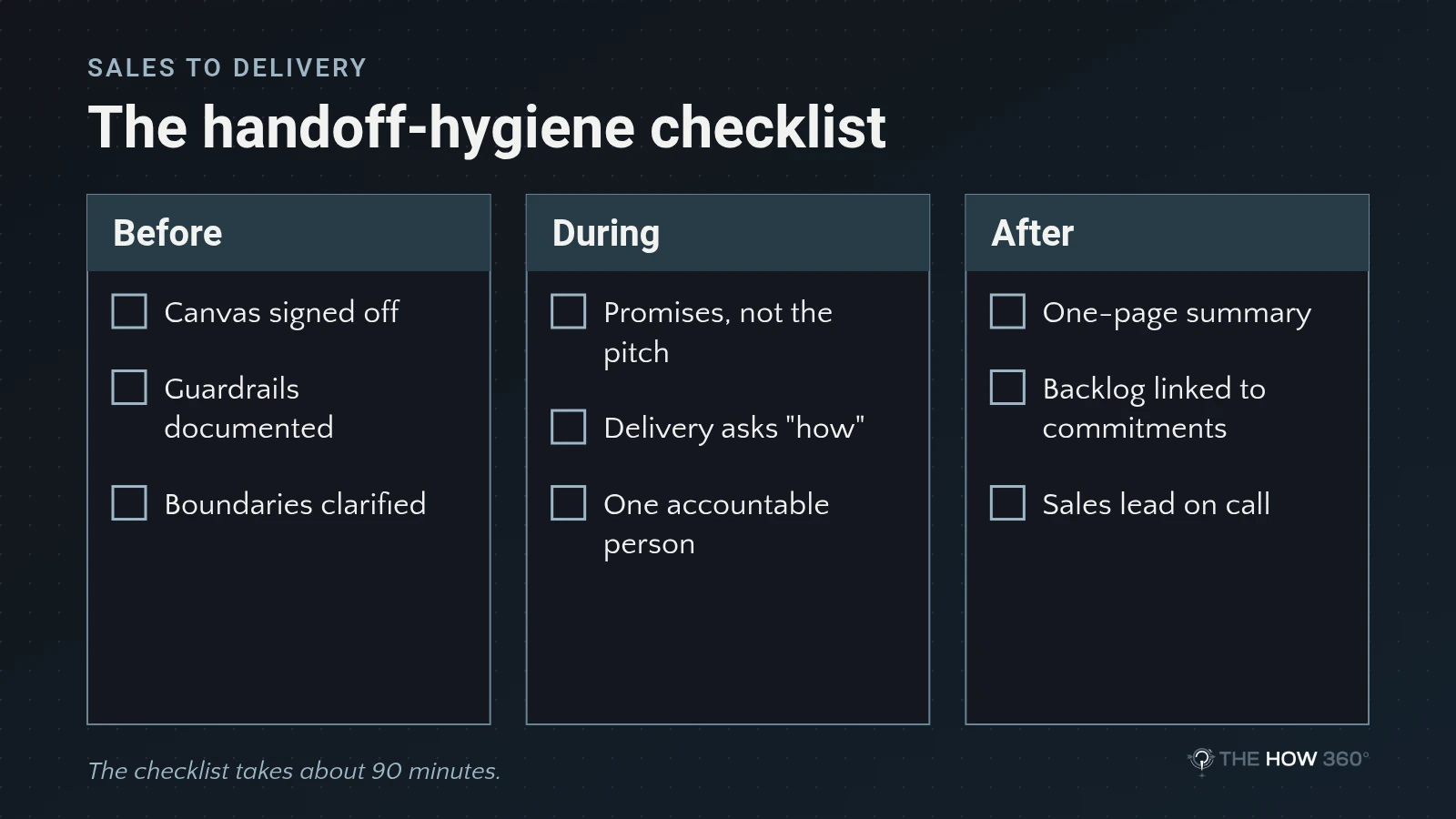
The handoff is the most fragile moment in the project. In my experience, a clean handoff is where most rework is won or lost. This is the checklist I require before any project moves from sales to delivery.
Before the handoff meeting:
During the handoff meeting:
After the handoff meeting:
The checklist takes about 90 minutes. In my experience it saves weeks of rework.
Even with a clean handoff, things fall apart when roles are fuzzy. For each commitment, name one accountable owner (the DRI), who does the work, who must be consulted and who only needs to be informed.
| Commitment | Accountable (DRI) | Responsible | Consulted | Informed |
|---|---|---|---|---|
| 24/7 support | Delivery lead | Support team | Sales lead, client IT | Client VP, CFO |
| AI-driven recommendations | Product manager | Data science team | Client data owner | Marketing director |
Share that map with the client. Yes, really. It removes the "I thought you were doing that" conversations that burn time and trust. Part 5 of this series, Role-Clarity Mapping: Who Owns What When Strategy Meets Reality, shows how to run the full session.
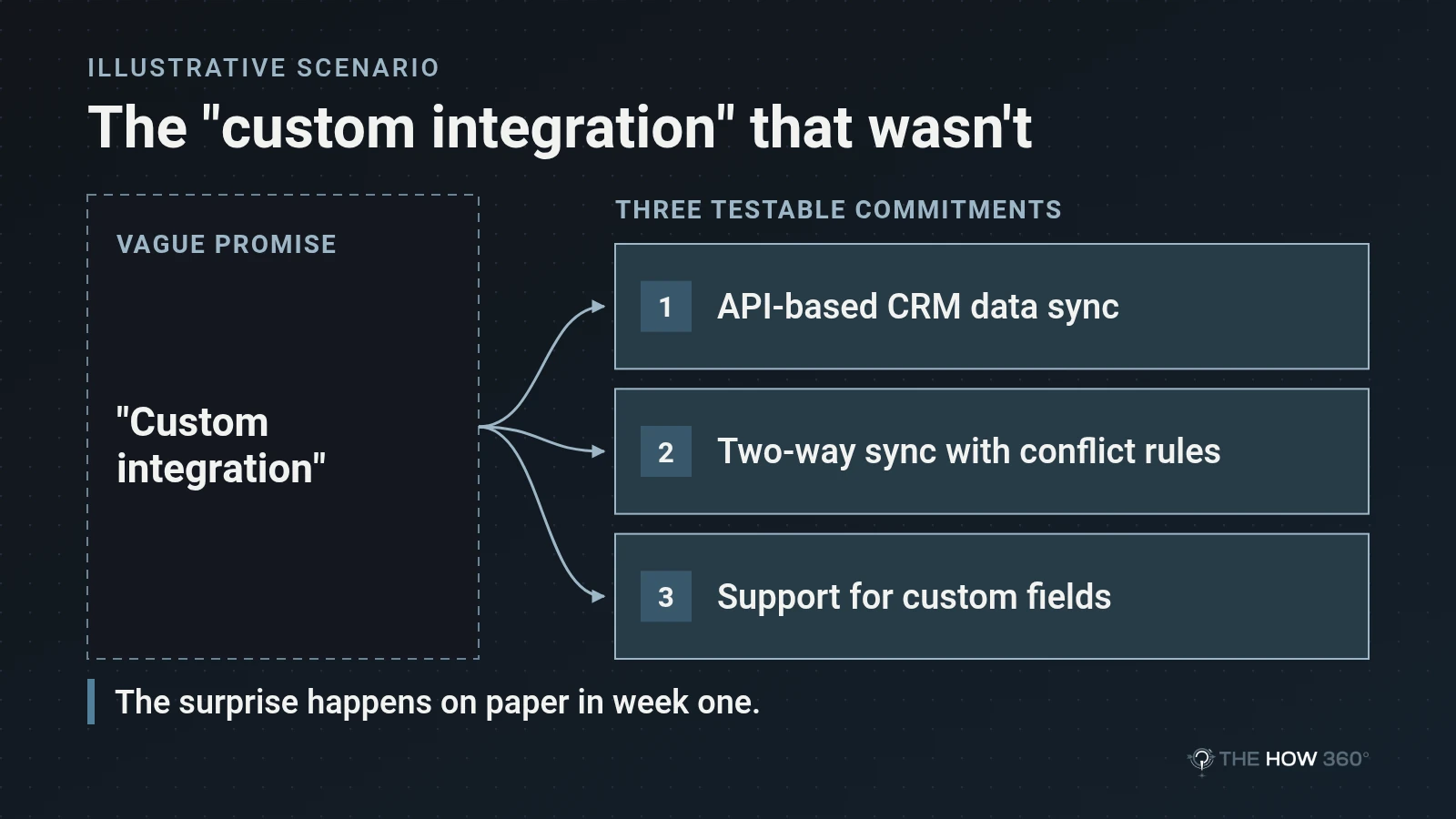
Here is an illustrative scenario. A software company keeps selling a "custom integration." Halfway through each project, the delivery team discovers that the client's systems do not fit, and the work starts over.
With the translation layer, sales and delivery sit down with the commitment canvas before the handoff. They flag "custom integration" as a vague promise and break it into three:
Each commitment gets a handoff check and an owner. The delivery team knows what to build, and the client knows whom to ask about what.
That is the difference: the surprise happens on paper in week one, not in the code in month three.
You do not need a transformation programme to start. Start next week.
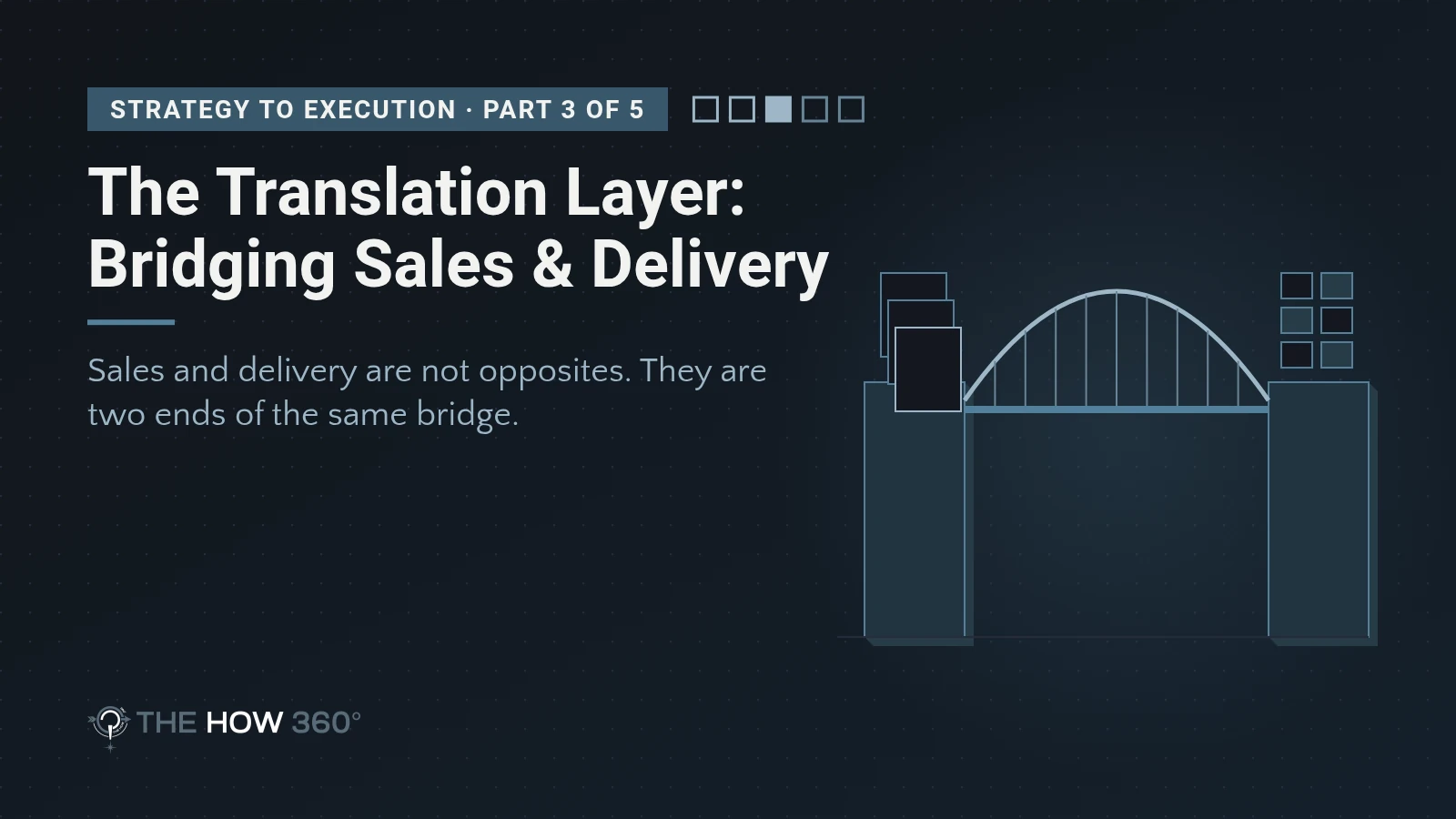
Sales and delivery are not opposites. They are two ends of the same bridge, and the translation layer is the steel that holds it up.
Without it, promises evaporate, margins shrink and teams burn out. With it, you get predictability, healthier margins and a team that actually enjoys delivering what was sold.
So when your next deal is signed, who in your company sits down and translates it?
Read next: Part 4 of the series, Value-Focused Execution: Connecting Daily Tasks to Strategic Outcomes. For the bigger picture, go back to Why 90% of IT Strategies Fail, and How to Fix It.
Want handoffs that hold? See how I help with Complex Project & Programme Management.
Stay up to date with my informative blog posts.
Struggling with complex projects, IT leadership challenges, or strategic execution? With over 30 years of experience in delivering high-impact results—whether rescuing delayed initiatives, optimizing resources, or driving transformation—I provide the clarity, structure, and leadership needed for success.
Let’s discuss how I can help you achieve your goals. Schedule a call today!


We only use necessary cookies unless you agree to statistics (Google Analytics), which help us see which articles are read. You can change your choice at any time. Read the privacy policy