It is not a lack of good intentions or visionary goals that kills IT strategies. It is the lack of the most important question: How? Learn why 90% of strategies fail and how to fix it.
Strategy to Execution, part 1
Every year, boards approve ambitious IT strategies. Twelve months later, many of them live in a forgotten slide deck. I have watched that happen for 30 years, and the cause is almost never the strategy itself.
The gap sits between the plan and Monday morning. In this article I look at what the research actually says about strategy failure, the five reasons I see again and again, and a four-step way to start closing the gap next week.
Digital transformation. Cloud migration. AI integration. The presentations are polished, the business cases are convincing, and the budgets get approved.
Then nothing happens.
Or rather, something happens, but not what was intended. Projects start and stop. Priorities shift. Teams work hard but pull in different directions. Everybody is busy, and the strategy quietly stops being the thing that decides what people do.
I call this the strategy-execution gap. Across turnarounds and while building and maturing delivery and project organisations, I have seen the same pattern in companies of every size. Small companies hit it with one big initiative. Large companies hit it with twenty at once.
You will often read that 60 to 90% of strategies fail. Be careful with that number.
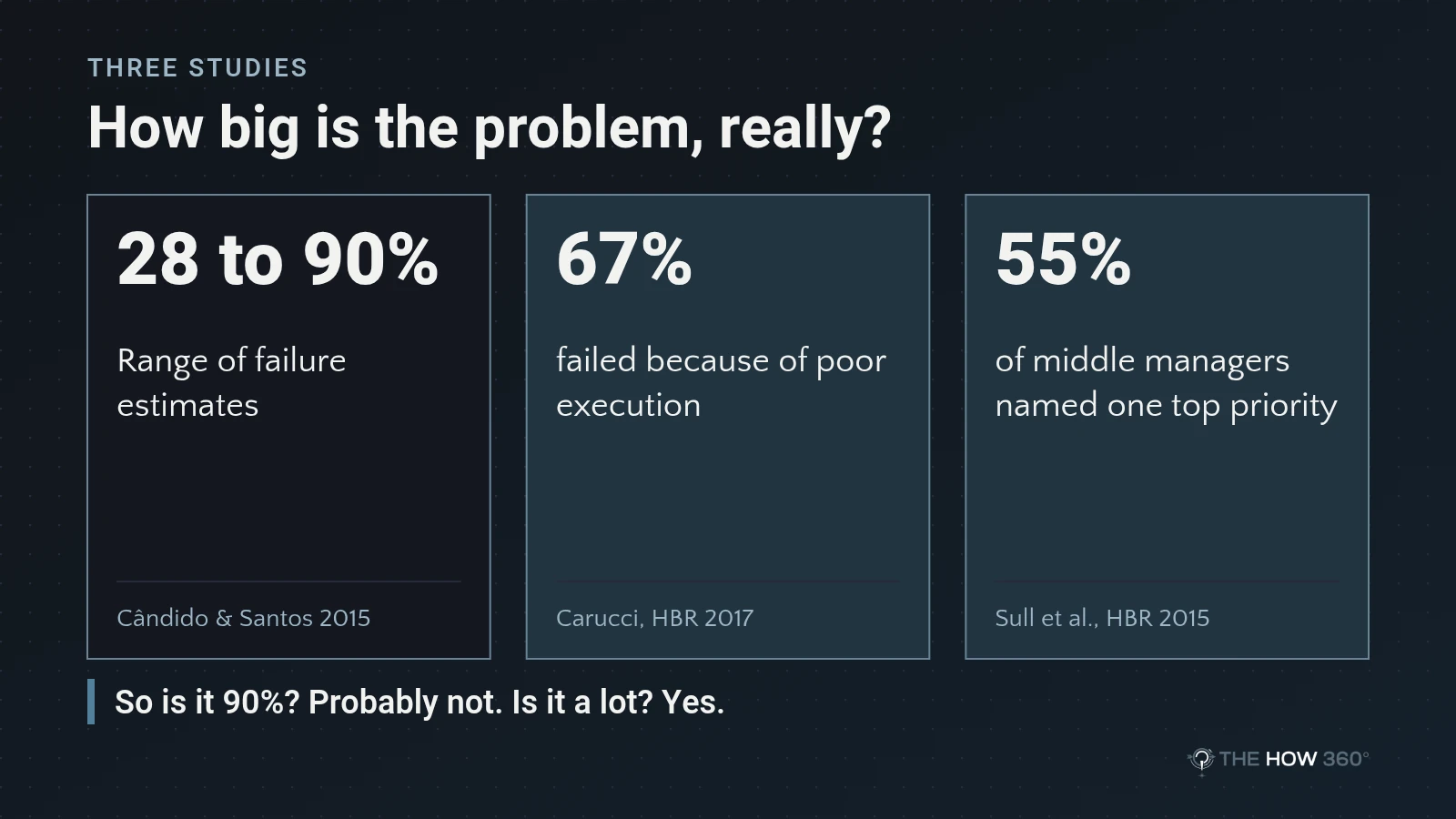
Ron Carucci wrote in Harvard Business Review that in 2016 an estimated 67% of well-formulated strategies failed because of poor execution (Carucci, HBR 2017). His firm's 10-year study of executives found that 61% said they were not prepared for the strategic challenges they faced when they were appointed to senior roles.
The higher figures are shakier. Cândido and Santos reviewed the research behind the famous "50 to 90%" claims, including the one often credited to Kaplan and Norton. Estimates for strategy implementation in general ranged from 28 to 90%. Their conclusion: most estimates rest on evidence that is "outdated, fragmentary, fragile, or just absent," and the true failure rate remains to be determined (Cândido & Santos 2015).
So is it 90%? Probably not. Is it a lot? Yes. Sull, Homkes and Sull surveyed nearly 8,000 managers in more than 250 companies and found that only 55% of middle managers could name even one of their company's top five priorities (Sull, Homkes & Sull, HBR 2015). If people cannot name the strategy, they cannot execute it.
I do not need the exact number. I need to know why it happens.
Over 30 years in IT and tech, I keep finding the same five reasons why strategies, programmes and projects deliver less than they could:

At TheHow360 I do not start with frameworks. I start with four questions, and they work as a simple four-step routine:
The answer is not another certification or methodology. It is operational discipline that fits your context: pragmatic, framework-agnostic, and focused on the few drivers that actually produce results.
I call this approach The How, because "how" is the question that decides the outcome.

Here is an illustration of the difference, built from the pattern above rather than from one specific client.
A mid-sized company approves a cloud-migration strategy. In version one, the board signs off, a programme is announced, and every team adds "cloud" to its backlog. Six months later, three teams have migrated test environments, nobody has decommissioned anything, and the business case is still a slide.
In version two, the same strategy goes through the four questions first. Weekly priorities are written for the first quarter. Two decisions get a gate, everything else goes through the normal flow. One person owns the translation between the CFO's savings target and the platform team's backlog. Progress is measured in systems switched off, not in tickets closed.
Same strategy. Same people. Very different Mondays.
You can start this week without a transformation programme:
The gap between strategy and execution is rarely a technology problem or a process problem. Most of the time it is a translation problem.
Like any translation, it needs someone who speaks both languages: the boardroom's concerns about risk and ROI, and the developer's reality of technical debt and delivery cycles. Someone who can take "digital transformation" and turn it into "here is what we do next week."
That is what this blog is about. Pragmatic tools, decision mechanisms you can use straight away, and honest notes on what works and what does not.
So, what would your managers say if you asked them to name the strategy tomorrow?
Read next: Part 2 of the series, The Governance That Enables (Instead of Killing) Innovation, shows how to keep control without losing speed. You may also like Role-Clarity Mapping: Who Owns What When Strategy Meets Reality.
Need help closing the gap? See how I work with leadership teams on IT Leadership Consulting & Strategy Execution.
Stay up to date with my informative blog posts.
Struggling with complex projects, IT leadership challenges, or strategic execution? With over 30 years of experience in delivering high-impact results—whether rescuing delayed initiatives, optimizing resources, or driving transformation—I provide the clarity, structure, and leadership needed for success.
Let’s discuss how I can help you achieve your goals. Schedule a call today!


We only use necessary cookies unless you agree to statistics (Google Analytics), which help us see which articles are read. You can change your choice at any time. Read the privacy policy