A practical framework for maintaining value-focused execution — ensuring daily tasks connect to strategic outcomes and don't drift into productive busywork.
Strategy to Execution, part 4
Strategy does not fail in the planning room. It fails in the thousand small choices made between 9 and 5.
You can have a sharp strategy and a well-translated backlog and still go nowhere for months. This article shows how to keep every task tied to an outcome, with three practices, a weekly ritual, the traps to avoid and a four-step plan you can start this week.
You did the strategy workshop. Your priorities are clear, your outcomes are mapped, and your backlog is supposedly aligned.
Then Monday morning hits.
A developer sits down to refactor an API endpoint. A support agent handles a ticket about a missing invoice. A marketing manager drafts copy for a landing page. Somewhere in all that productive motion, the strategy disappears.
The API refactor? "It was in the backlog." The support ticket? "Just doing my job." The landing page? "We need more leads."
None of them can tell you in one sentence how today's work connects to the outcome it was meant to move. And if they cannot, neither can you.
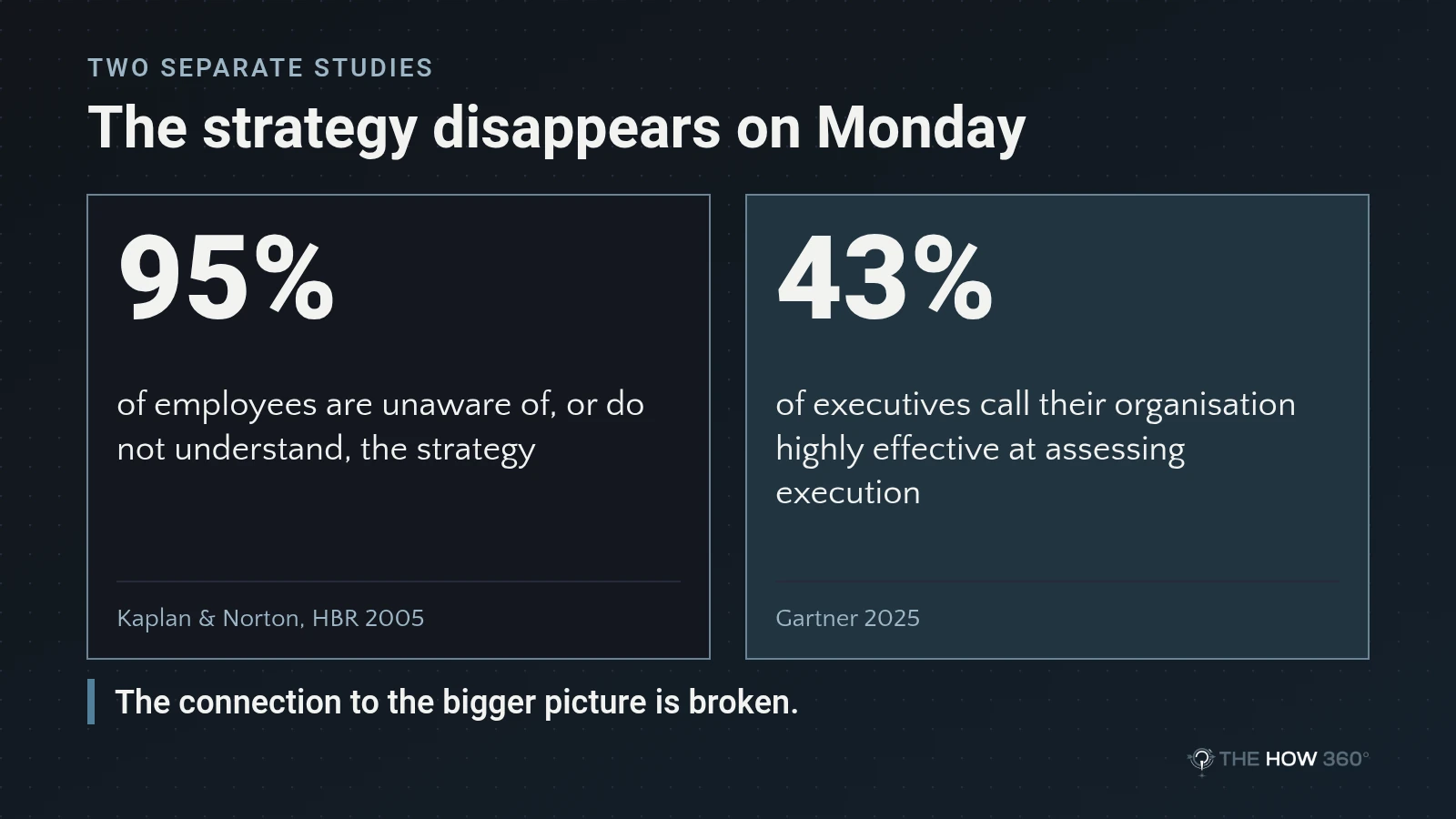
That is not a rare problem. Kaplan and Norton reported that on average 95% of a company's employees are unaware of, or do not understand, its strategy (Kaplan & Norton, HBR 2005). Part 1 of this series, Why 90% of IT Strategies Fail, and How to Fix It, shows how few middle managers can even name one of their company's top priorities. And in Gartner's research, only 43% of executives consider their organisation highly effective at assessing its ability to execute strategy (Gartner 2025).
People care. The connection between their work and the bigger picture is simply broken, or it was never built.
Value-focused execution is the discipline of keeping every task, meeting and metric explicitly tied to a strategic outcome. It is not about working harder. It is about working with the outcome in view.
If translating strategy into a backlog builds the railway, value-focused execution makes sure every train on it is going somewhere that matters. Without it, you get busywork at scale: teams that are productive, efficient and completely misaligned.
Most backlogs are lists of activities. "Fix login bug." "Update Q2 report."
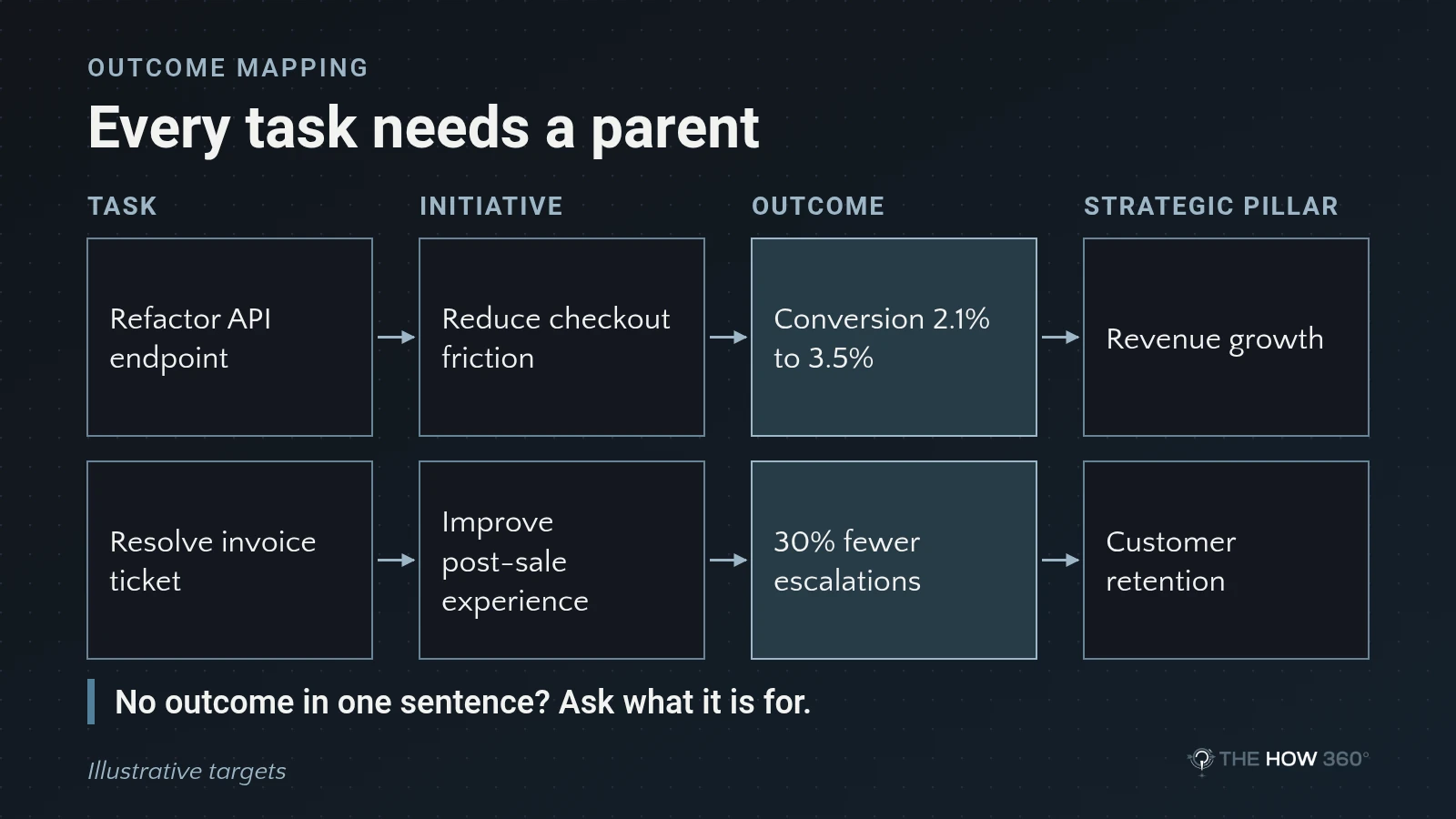
Flip it. Every task must trace back to an outcome: a measurable change in behaviour or performance. My test: "What will be different in the world when this is done?" If the answer is "the report will be updated," you have an activity. If it is "leadership will move budget to the initiatives with the best return," you have an outcome.
In practice, tag every backlog item with its parent. The targets below are illustrative:
| Task | Initiative | Outcome | Strategic pillar |
|---|---|---|---|
| Refactor API endpoint | Reduce checkout friction | Conversion from 2.1% to 3.5% | Revenue growth |
| Resolve invoice ticket | Improve post-sale experience | 30% fewer support escalations | Customer retention |
| Draft landing page copy | Nordic market entry | 500 qualified leads in Q2 | Market expansion |
It takes seconds per task, and it changes every conversation. A developer who knows the refactor is about conversion makes different decisions.
Rule of thumb: if you cannot map a task to an outcome in one sentence, ask what it is for before it goes into the sprint.
Once a week, pick five items from the current sprint and ask:
This is not micromanagement. It is a regular check that the work still serves the goal. Backlogs collect tasks that made sense three months ago. The test clears out what no longer earns its place.
In my experience, the first time a team runs the test, the list gets shorter, and the work that remains is easier to explain.
People cannot act on what they cannot see. If the strategy lives in a 40-slide deck and the tasks live in Jira, the link is invisible, and invisible links break. Pick one format:
The test: anyone on the team can trace their work to the strategy in under 30 seconds.
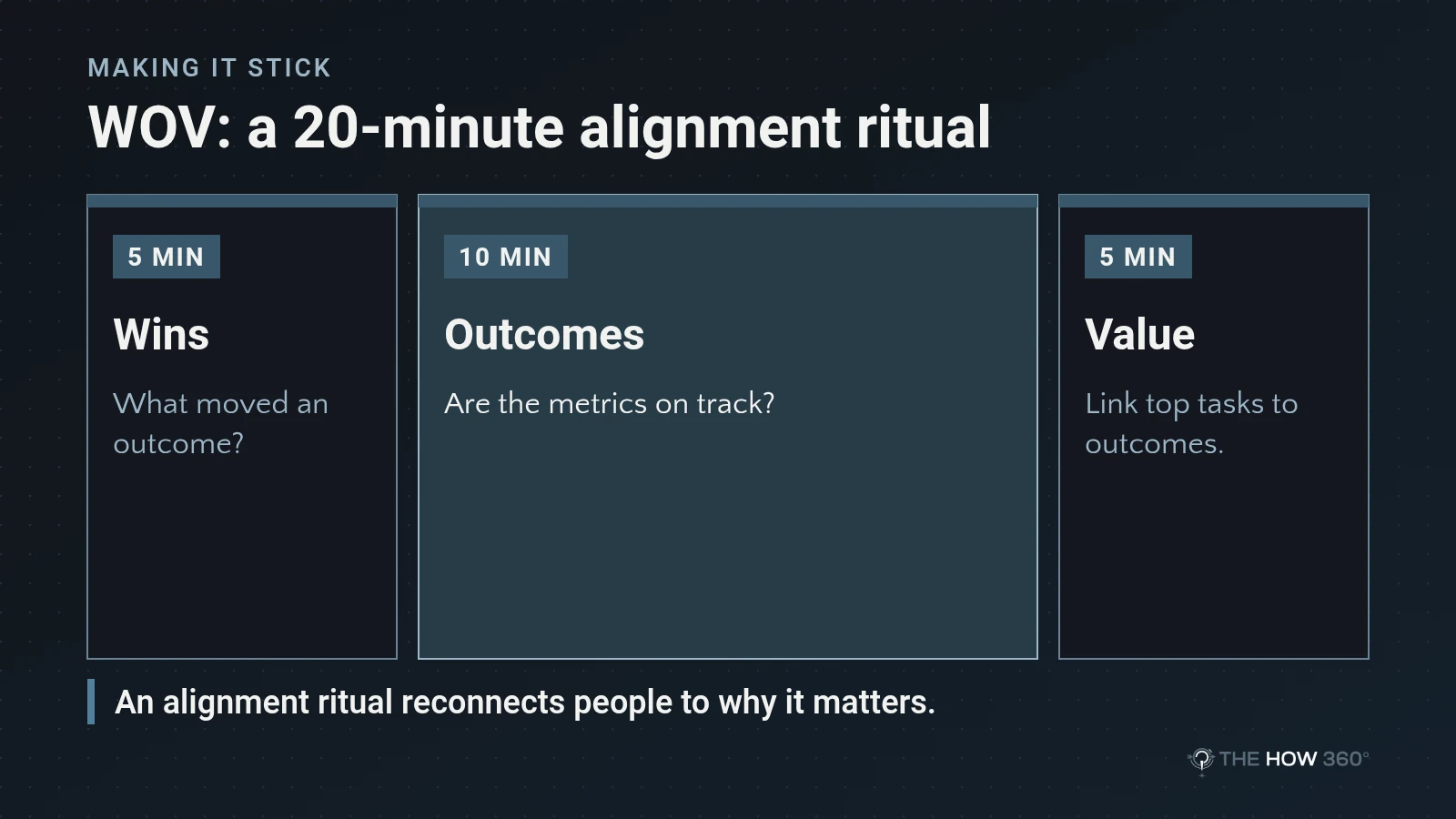
A status update tells people what happened. An alignment ritual reconnects them to why it matters. I use a 20-minute format called WOV:
Add one question to backlog grooming: "Is this still the best use of our time?" Sort by outcome, rank by value against effort, and cut or defer the bottom of the list. If your backlog has not changed in a month, it is a wish list.
Then fix the metrics. Measure tickets closed and you get tickets closed, whether they matter or not. Track leading indicators (the share of sprint items mapped to an active outcome), the outcome itself (conversion, retention, time to market) and health (burnout, customer satisfaction).
Here is an illustrative scenario. A logistics company sets a clear goal: next-day delivery for most orders. The backlog fills with warehouse improvements, routing work and partner integrations.
Months later, delivery times have not moved, even though tickets close and sprints complete.
Then the team starts each weekly stand-up with the delivery metric and tags every task with its expected effect on it. The pattern shows quickly: the team is speeding up warehouse picking, while the real delay sits in the handoff to delivery partners. The effort moves to where the outcome is stuck.
The strategy was right, and the backlog looked right. Tying each task to the outcome showed where the work belonged.
A good backlog gets the strategy into the plan. Value-focused execution gets it into the day's work.
The question is not whether your team works hard. It is whether that work is connected to outcomes that matter.
Which of this week's tasks would survive the "so what?" test in your team?
Read next: Part 5 of the series, Role-Clarity Mapping: Who Owns What When Strategy Meets Reality. If you missed it, part 1 is Why 90% of IT Strategies Fail, and How to Fix It.
Want your strategy to show up on Monday? See how I work on IT Leadership Consulting & Strategy Execution.
Stay up to date with my informative blog posts.
Struggling with complex projects, IT leadership challenges, or strategic execution? With over 30 years of experience in delivering high-impact results—whether rescuing delayed initiatives, optimizing resources, or driving transformation—I provide the clarity, structure, and leadership needed for success.
Let’s discuss how I can help you achieve your goals. Schedule a call today!


We only use necessary cookies unless you agree to statistics (Google Analytics), which help us see which articles are read. You can change your choice at any time. Read the privacy policy